
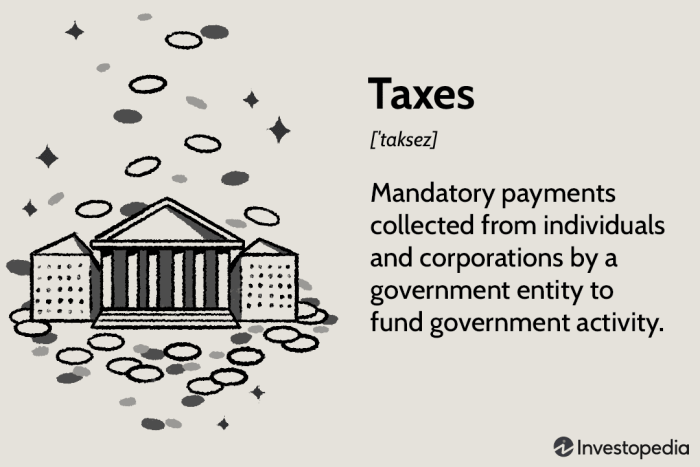
What are taxes? The question, deceptively simple, unlocks a complex web of economic and societal functions, impacting every facet of our lives. From funding essential public services like education and healthcare to shaping economic stability, taxes are the lifeblood of modern governments. This exploration delves into the multifaceted world of taxation, dissecting its core principles, various forms, and the intricate processes that govern its collection and administration.
This comprehensive analysis will examine the fundamental purpose of taxation, exploring how it fuels social welfare programs and contributes to economic equilibrium. We’ll navigate the nuances of different tax systems – progressive, regressive, and proportional – and their implications for income distribution. Furthermore, we will dissect the mechanics of tax collection, from filing returns to the enforcement activities of government agencies. Finally, the role of tax deductions and credits will be examined, alongside the importance of tax planning strategies for individuals and businesses, concluding with an overview of the complexities of international taxation.
Understanding the Fundamental Purpose of Taxation in Society is Essential
Taxation is a cornerstone of modern society, acting as the primary mechanism through which governments generate revenue to fund essential public services and implement social programs. Understanding the fundamental purposes of taxation is crucial for informed citizenship and a functional democracy. This article delves into the core objectives that taxation serves, examining its role in financing public services, supporting social welfare, and contributing to economic stability.
Funding Public Services
The most fundamental purpose of taxation is to finance the provision of essential public services. These services are vital for the well-being and prosperity of a nation.
- Education: Taxes fund public schools, universities, and vocational training programs. This ensures access to education for all citizens, fostering a skilled workforce and promoting social mobility. The quality of education, from primary to tertiary levels, is directly correlated with a nation’s investment in its education system, which is largely dependent on tax revenues.
- Healthcare: Taxation supports healthcare systems, including hospitals, clinics, and public health initiatives. Access to affordable healthcare is a key indicator of a nation’s quality of life. Countries with robust tax-funded healthcare systems generally exhibit better health outcomes and longer life expectancies.
- Infrastructure: Taxes finance the construction and maintenance of essential infrastructure, such as roads, bridges, public transportation systems, and utilities. Efficient infrastructure is crucial for economic activity, facilitating trade, transportation, and communication. A well-maintained infrastructure network reduces transportation costs, improves connectivity, and attracts investment.
- Public Safety: Taxation provides resources for law enforcement, the judiciary, and the armed forces, ensuring public safety and national security. A secure environment is essential for economic growth and social stability.
Social Welfare Programs
Taxation plays a crucial role in funding and sustaining social welfare programs designed to protect vulnerable populations and promote social equity. These programs are often viewed as a safety net, providing support to those who are unable to meet their basic needs.
- Unemployment Benefits: Taxes fund unemployment insurance programs, providing financial assistance to individuals who have lost their jobs. These benefits help individuals meet their basic needs while they search for new employment, mitigating the economic impact of job losses.
- Social Security/Pension Programs: Taxation supports retirement benefits for the elderly and disabled. These programs provide a stable income stream, reducing poverty and improving the quality of life for retirees. The sustainability of these programs is often a subject of public debate, requiring careful management of tax revenues and demographic trends.
- Food Assistance: Programs like food stamps (Supplemental Nutrition Assistance Program – SNAP) are funded by tax revenue and provide low-income individuals and families with access to nutritious food. These programs are essential for combating food insecurity and improving overall health outcomes.
- Housing Assistance: Taxation can fund housing subsidies and programs that provide affordable housing options. These programs help individuals and families secure stable housing, reducing homelessness and improving living conditions.
These social welfare programs are often subject to economic cycles and demographic changes. Careful planning and management of tax revenues are essential to ensure the sustainability and effectiveness of these vital support systems.
Economic Stability
Taxes also play a critical role in maintaining economic stability by influencing inflation, government spending, and the overall financial health of a nation. Governments use fiscal policy, which involves taxation and spending, to manage the economy.
- Controlling Inflation: During periods of high inflation, governments may increase taxes to reduce disposable income and curb consumer spending, thereby helping to cool down the economy.
- Government Spending: Tax revenues fund government spending on goods and services, which can stimulate economic activity. Increased government spending can boost demand and create jobs, especially during economic downturns.
- Debt Management: Tax revenues are used to service government debt, which helps maintain investor confidence and prevents unsustainable debt levels. Efficient debt management is crucial for long-term economic stability.
- Economic Inequality: Progressive tax systems, where higher earners pay a larger percentage of their income in taxes, can help reduce income inequality. The revenue generated can be used to fund social programs that benefit lower-income individuals and families.
Fiscal policy is a powerful tool for managing the economy, but its effectiveness depends on careful planning, implementation, and coordination with monetary policy.
Different Types of Taxes Affect Citizens in Various Ways
Understanding how different tax systems and specific taxes function is crucial for evaluating their impact on individuals and the broader economy. Taxes, a fundamental aspect of modern society, are levied by governments to fund public services and infrastructure. However, the way these taxes are structured and applied can have vastly different consequences for citizens, influencing income distribution, economic behavior, and perceptions of fairness.
Progressive, Regressive, and Proportional Tax Systems
Tax systems are categorized based on how the tax burden changes relative to income. Each system has distinct implications for income distribution and perceived fairness.
A progressive tax system imposes a higher tax rate on individuals with higher incomes. The rationale behind progressive taxation is to redistribute wealth and reduce income inequality.
For example, consider a hypothetical tax system with the following brackets:
* Income up to $50,000: 10% tax rate
* Income between $50,001 and $100,000: 20% tax rate
* Income above $100,000: 30% tax rate
Under this system, a person earning $40,000 would pay 10% of their income in taxes. A person earning $75,000 would pay 10% on the first $50,000 and 20% on the remaining $25,000. Finally, someone earning $150,000 would pay 10% on the first $50,000, 20% on the next $50,000, and 30% on the remaining $50,000. The effective tax rate increases as income rises. The United States federal income tax system is an example of a progressive tax system.
A regressive tax system places a greater burden on lower-income individuals, even if the tax rate is the same for everyone. This occurs because lower-income individuals spend a larger proportion of their income on taxable goods and services.
For instance, a sales tax is often considered regressive.
Let’s imagine a 5% sales tax on all purchases. A person earning $20,000 per year and spending nearly all of it on taxable items will pay a larger percentage of their income in sales tax compared to a person earning $200,000 per year, even if both individuals buy the same goods. The lower-income individual has less disposable income remaining after paying the tax.
A proportional tax system, also known as a flat tax, applies the same tax rate to all income levels.
A flat tax of 20% would mean everyone pays 20% of their income in taxes, regardless of their earnings. While appearing simple and fair on the surface, proportional taxes can still affect income distribution. The impact depends on the level at which the flat tax is set. A higher flat tax rate might disproportionately affect lower-income earners, while a lower rate might benefit higher earners more.
The choice of tax system has profound implications for social equity and economic stability. Progressive systems aim to reduce income inequality, while regressive systems can exacerbate it. Proportional systems seek to offer simplicity and neutrality, but the chosen rate plays a crucial role in its distributional effects.
Different Types of Taxes and Their Impacts
Various types of taxes are used by governments to generate revenue, each affecting different segments of the population in unique ways. These taxes can target income, property, sales, or specific goods and services.
Here is an overview of several common tax types and their effects:
-
Income Tax:
This is a tax levied on the earnings of individuals and corporations. It is a primary source of government revenue in many countries.- Impact: Generally, income tax is progressive, with higher earners paying a larger percentage of their income. This can affect incentives to work and invest.
- Examples: The US federal income tax, state income taxes, and corporate income tax.
-
Property Tax:
Property tax is a tax on real estate and other property owned by individuals or businesses.- Impact: Property taxes are often regressive, as they can disproportionately affect lower-income homeowners or renters, who may spend a larger portion of their income on housing costs.
- Examples: Taxes on homes, land, and commercial buildings.
-
Sales Tax:
Sales tax is a tax on the purchase of goods and services.- Impact: Sales taxes are typically regressive, as lower-income individuals spend a greater percentage of their income on taxable items.
- Examples: State and local sales taxes on retail purchases.
-
Excise Tax:
Excise taxes are levied on specific goods or services, such as gasoline, tobacco, and alcohol.- Impact: Excise taxes can be regressive if the taxed goods or services are consumed more by lower-income individuals. They can also be used to discourage the consumption of harmful products.
- Examples: Taxes on gasoline, cigarettes, and alcohol.
-
Estate Tax (Inheritance Tax):
This tax is levied on the transfer of assets from a deceased person to their heirs.- Impact: Estate taxes are generally progressive, affecting only high-net-worth individuals.
- Examples: The US federal estate tax.
These different types of taxes, when combined, create a complex tax landscape that can influence economic behavior and impact income distribution. Policymakers must carefully consider the effects of each tax type when designing tax policies to achieve their desired economic and social goals. The effectiveness and fairness of a tax system depend on the interplay of these different taxes and the specific rates and exemptions applied.
The Process of Tax Collection and Administration Requires Specific Procedures
The collection and administration of taxes are complex processes, crucial for funding public services and infrastructure. These procedures, governed by specific laws and regulations, ensure that governments receive the necessary revenue to operate effectively. Understanding these processes is vital for both taxpayers and government agencies, promoting transparency and accountability in the fiscal system.
Tax Collection: A Step-by-Step Approach
The tax collection process involves a series of carefully orchestrated steps, beginning with taxpayers fulfilling their obligations and culminating in the government’s receipt of funds. This intricate process is designed to ensure fairness, accuracy, and efficiency in the collection of taxes.
The initial step in tax collection is the filing of tax returns. Taxpayers, whether individuals or businesses, are required to declare their income, deductions, and credits to the relevant tax authority, usually annually. Accurate and timely filing is paramount. Following the filing of tax returns, the tax agency undertakes a process of assessment. This involves reviewing the submitted information, verifying its accuracy, and calculating the tax liability. The agency may request additional documentation or information from the taxpayer to support the claims made. After the assessment, the tax is levied, and the taxpayer is notified of the amount due. Payment of the assessed tax then follows. This payment can be made through various methods, such as online portals, mail, or direct bank transfers. Tax agencies have established deadlines for tax payments, and taxpayers are required to adhere to these deadlines to avoid penalties.
Tax agencies also have the power to enforce tax laws and regulations. This includes the ability to audit taxpayers, investigate suspected tax evasion, and impose penalties for non-compliance. Audits are conducted to verify the accuracy of tax returns and ensure compliance with tax laws. Investigations may be initiated if there is reason to believe that a taxpayer has engaged in tax evasion or other fraudulent activities. Penalties, such as fines and interest, are imposed on taxpayers who fail to comply with tax laws, including late filing, underpayment, or deliberate evasion.
Below is a table summarizing the key stages of the tax collection process, the responsible parties involved, and the actions taken at each stage.
| Key Stage | Responsible Party | Actions Involved | Example |
|---|---|---|---|
| Filing of Tax Returns | Taxpayer (Individual or Business) |
|
A salaried employee files their W-2 form, reporting their income and deductions. |
| Assessment | Tax Agency (e.g., IRS in the U.S.) |
|
The IRS checks the income reported on the W-2 form against the tax return to ensure consistency. |
| Levy and Payment | Taxpayer |
|
A taxpayer pays their assessed tax liability through the IRS online portal. |
| Enforcement | Tax Agency |
|
The IRS audits a business suspected of underreporting its income, leading to penalties and back taxes. |
The Concept of Tax Deductions and Credits Can Reduce Taxable Income
Tax deductions and tax credits are fundamental components of the tax system, offering individuals and businesses ways to potentially reduce their tax liability. They are essentially mechanisms designed to alleviate the financial burden of taxes, often by recognizing specific expenses or incentivizing certain behaviors deemed beneficial to society. Understanding how these tools work is crucial for effective tax planning and financial management.
How Tax Deductions and Credits Function
Tax deductions and credits are designed to lower the amount of tax owed. A tax deduction reduces taxable income, which is the amount of income on which taxes are calculated. A tax credit, on the other hand, directly reduces the amount of tax owed. This difference is significant, as a tax credit typically provides a more significant tax benefit than a deduction of the same amount.
Tax deductions are available for various expenses, such as charitable contributions, certain medical expenses, and business expenses. When an individual or business claims a deduction, they subtract the eligible expense from their gross income to arrive at their adjusted gross income (AGI) or taxable income. The tax liability is then calculated based on this reduced taxable income.
Tax credits, however, directly reduce the amount of tax owed. This means that a tax credit of a certain amount provides a dollar-for-dollar reduction in the tax liability. Credits are available for various purposes, including education expenses, child care expenses, and energy-efficient home improvements.
Distinguishing Between Tax Deductions and Tax Credits
The primary difference between tax deductions and tax credits lies in their impact on tax liability. Deductions reduce taxable income, while credits directly reduce the tax amount owed. This distinction has important implications for tax planning and the overall tax benefit.
* Tax Deductions: Reduce taxable income. They are more valuable to those in higher tax brackets, as the reduction in taxable income results in a greater tax savings. However, the tax savings depend on the taxpayer’s marginal tax rate.
* Tax Credits: Directly reduce the amount of tax owed. A $1,000 tax credit reduces the tax liability by $1,000, regardless of the taxpayer’s tax bracket. This makes credits particularly beneficial for lower-income taxpayers.
Here’s an example:
Suppose a taxpayer has a taxable income of $50,000 and a tax liability of $6,000. If the taxpayer is eligible for a $1,000 tax deduction, their taxable income would be reduced to $49,000. If they are in the 22% tax bracket, this deduction would save them $220 in taxes ($1,000 x 0.22). Conversely, if the taxpayer is eligible for a $1,000 tax credit, their tax liability would be reduced to $5,000, resulting in a direct tax savings of $1,000.
Examples of Tax Deductions and Tax Credits
Tax deductions and credits are implemented to provide relief for specific financial burdens. The following examples highlight how these tools can reduce taxable income and tax liability.
* Charitable Contribution Deduction: Individuals who donate to qualified charitable organizations can deduct the amount of their contributions. This deduction reduces their taxable income, lowering their tax liability.
Sarah, a single taxpayer, donates $2,000 to a qualified charity. If she is in the 22% tax bracket, she can deduct $2,000 from her taxable income, resulting in a tax savings of $440 ($2,000 x 0.22).
* Child Tax Credit: This credit provides a tax benefit for taxpayers with qualifying children. The credit reduces the tax liability dollar-for-dollar.
John and Mary have a qualifying child. They are eligible for a $2,000 child tax credit per child. This credit directly reduces the amount of taxes they owe by $2,000, offering substantial financial relief.
* Student Loan Interest Deduction: Taxpayers can deduct the interest they pay on qualified student loans, up to a certain limit. This deduction reduces their taxable income.
David paid $1,500 in student loan interest during the tax year. He can deduct this amount from his taxable income, reducing his tax liability. If he is in the 22% tax bracket, this deduction will save him $330 in taxes ($1,500 x 0.22).
Tax Planning Strategies and their Importance for Individuals and Businesses are Paramount
Effective tax planning is a critical component of sound financial management, both for individuals and businesses. It involves strategically organizing financial affairs to minimize tax liabilities legally and ethically. By proactively considering tax implications, individuals and companies can potentially retain more of their earnings, invest more effectively, and achieve their financial goals more efficiently.
The Importance of Tax Planning in Minimizing Tax Obligations
Tax planning is not merely about finding loopholes; it is about understanding and utilizing the tax laws to one’s advantage. This proactive approach helps individuals and businesses to legally minimize their tax obligations. This strategic process involves analyzing financial situations, anticipating future tax liabilities, and implementing strategies to reduce those liabilities. For individuals, this can mean maximizing deductions, contributing to tax-advantaged retirement accounts, or strategically timing income and expenses. For businesses, tax planning involves choosing the optimal business structure, taking advantage of available credits and incentives, and making informed investment decisions. The ultimate goal is to optimize financial outcomes within the bounds of the law, ensuring compliance while maximizing after-tax returns.
Legal and Ethical Boundaries of Tax Planning
Distinguishing between legitimate tax planning and illegal tax evasion is paramount. Tax planning, as previously mentioned, involves utilizing legal strategies to minimize tax obligations. Tax evasion, on the other hand, is the illegal act of intentionally avoiding paying taxes. This includes deliberately underreporting income, inflating deductions, or concealing assets. For example, a legal tax planning strategy might involve contributing to a 401(k) retirement plan to reduce taxable income. This is permitted by law. Conversely, tax evasion might involve failing to report all income earned from a side business, which is illegal. Another example would be claiming a deduction for a charitable contribution that was never actually made, which is also illegal and unethical. The ethical boundaries are clear: all tax planning strategies must be transparent, accurately reported, and compliant with all applicable tax laws.
Tax Planning Strategies for Individuals and Businesses
Implementing effective tax planning strategies requires careful consideration of individual circumstances and business operations. Here are several strategies that individuals and businesses can employ:
- Maximizing Retirement Contributions: Individuals can significantly reduce their taxable income by contributing to 401(k) plans, IRAs, and other retirement accounts. The contributions are often tax-deductible, and the earnings grow tax-deferred.
- Utilizing Tax-Advantaged Investment Accounts: Investing in accounts like 529 plans for education savings or Health Savings Accounts (HSAs) can provide tax benefits, allowing for tax-free growth or tax-deductible contributions.
- Strategic Timing of Income and Expenses: Individuals can manage their tax liabilities by strategically timing when they recognize income and expenses. For example, deferring income to a future tax year or accelerating deductible expenses can be beneficial.
- Choosing the Right Business Structure: Businesses can optimize their tax obligations by selecting the appropriate legal structure (e.g., sole proprietorship, partnership, S-corporation, or C-corporation). Each structure has different tax implications.
- Taking Advantage of Business Deductions: Businesses can reduce their taxable income by claiming various deductions, such as business expenses, depreciation, and operating losses. Maintaining accurate records is crucial.
- Claiming Available Tax Credits: Both individuals and businesses can benefit from various tax credits, such as the Earned Income Tax Credit (EITC) for low-to-moderate-income workers or research and development (R&D) tax credits for businesses.
International Taxation is a Complex System Requiring Careful Consideration

The globalized economy necessitates a deep understanding of international taxation, a multifaceted field governing how cross-border transactions are taxed. Navigating this landscape is crucial for individuals with international assets and for multinational corporations operating across borders. This section will delve into the core principles, mechanisms, and implications of international taxation, highlighting its complexities and the strategies employed to manage tax liabilities effectively.
Basic Principles of International Taxation
International taxation is built on several key principles. The core concept involves the jurisdiction to tax, determined by residency, source of income, or a combination of both. This often leads to double taxation, where the same income is taxed by two or more countries. To mitigate this, countries employ various mechanisms.
One critical tool is the use of tax treaties, also known as double taxation avoidance agreements (DTAAs). These agreements, negotiated bilaterally between countries, aim to prevent or reduce double taxation and prevent tax evasion.
- Tax treaties typically allocate taxing rights between the countries involved, often based on the source of income. For example, a treaty might specify that investment income (dividends, interest, royalties) can be taxed by the source country but at a reduced rate or exempt altogether, depending on the recipient’s country of residence.
- Treaties also often include provisions to eliminate double taxation, such as the credit method, where a taxpayer can claim a credit in their country of residence for taxes paid in the source country.
- Another method is the exemption method, where income taxed in the source country is exempt from tax in the country of residence.
- Furthermore, tax treaties help to prevent tax evasion by providing for the exchange of information between tax authorities. This allows countries to investigate and prosecute tax fraud more effectively.
Impact of International Taxation on Multinational Corporations
Multinational corporations (MNCs) face a particularly complex international tax landscape. Their global operations expose them to multiple tax jurisdictions, necessitating sophisticated tax planning strategies.
One key aspect is transfer pricing, which involves setting the prices for transactions between related entities within an MNC.
The goal is to ensure that these prices reflect fair market value to avoid artificially shifting profits to low-tax jurisdictions. This is often scrutinized by tax authorities.
Tax havens, countries with low or no taxes, also play a significant role. MNCs may establish subsidiaries in tax havens to reduce their overall tax burden. However, these practices are increasingly subject to scrutiny and regulations aimed at preventing tax avoidance and base erosion and profit shifting (BEPS).
MNCs utilize a variety of strategies to manage their global tax liabilities. These can include:
- Careful structuring of their operations, including choosing the appropriate legal entities and locations for different activities.
- Utilizing tax treaties to minimize withholding taxes and access favorable tax rates.
- Employing transfer pricing strategies to allocate profits appropriately.
- Managing their effective tax rate through a combination of tax planning and compliance.
Comparative Analysis of Tax Systems
Understanding the variations in tax systems across countries is vital for international tax planning. The following table provides a simplified comparison of the tax systems of three countries, highlighting key aspects.
| Country | Corporate Tax Rate | Taxation of Dividends (for non-residents) | Key Features/Considerations |
|---|---|---|---|
| United States | 21% (Federal) + State Taxes | 30% withholding tax (reduced by tax treaties) | Worldwide taxation for U.S. corporations; complex rules regarding foreign tax credits; focus on anti-avoidance measures like Subpart F and GILTI. |
| United Kingdom | 25% | 0% (for dividends received from UK companies) | Territorial taxation system (generally); extensive treaty network; focus on transfer pricing and controlled foreign company (CFC) rules. |
| Singapore | 17% | 0% (for dividends paid from Singapore companies) | Territorial taxation system; attractive tax incentives for certain industries; strong treaty network; focus on attracting foreign investment. |
This table illustrates the significant variations in corporate tax rates, dividend taxation, and overall tax systems. The US, with its worldwide taxation system, contrasts with the UK and Singapore, which generally operate on a territorial basis. These differences have profound implications for MNCs, influencing their decisions regarding where to locate operations, how to structure their businesses, and how to manage their tax liabilities. The specific details, rules, and regulations can change, requiring ongoing monitoring and expert advice to ensure compliance and effective tax planning.
Ending Remarks
In conclusion, the world of taxes is a dynamic landscape, constantly evolving with economic and societal shifts. Understanding the fundamentals of taxation is crucial for informed citizenship and effective financial planning. From funding vital public services to navigating international financial complexities, taxes play a pivotal role. By grasping the intricacies of tax systems, collection processes, and strategic planning, individuals and businesses can better navigate this essential aspect of modern life, ensuring both compliance and financial well-being.
